
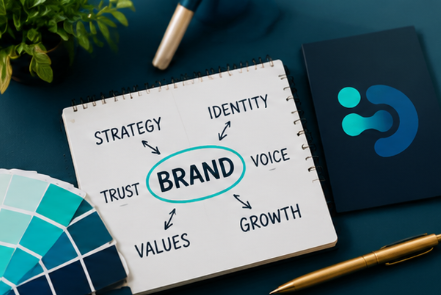
If you want to know how to build a brand for small business, begin with the way customers understand your offer. A logo can help people recognise you, but the brand also includes the message, the customer experience and the evidence behind your promises. Those parts work best when they tell a consistent story.
Brand building is a sequence of decisions. You decide who the business serves, what it stands for, how it speaks and how it looks. You then apply those decisions across the website, sales material and day-to-day service. This guide takes you through that process without assuming that a larger budget or a dramatic redesign is the first step.
1. Understand the people you want to serve
A brand cannot speak clearly to everyone at once. Start with the customers who are a good fit for the business. Describe what they need, how they choose a provider and which questions they ask before buying. Use real conversations, enquiry notes and customer feedback where you have permission to use them.
Demographics can provide context, but practical needs are often more useful for messaging. A busy shop owner may want fewer administrative tasks. A homeowner may want to understand a renovation process before requesting a quote. A new business may need a website that explains its offer quickly. The brand should connect to the actual situation rather than a vague label such as “ambitious people.”
Record what you know and what you still need to learn. Do not present an assumption as a customer insight. If the business serves several audiences, identify the main one for each service. This can help you decide which messages belong on the homepage and which need a dedicated page.
A useful audience brief
Write a short description covering the customer’s goal, the problem they want help with, the service they are considering and the information they need to trust the business. Keep it specific enough to guide decisions. A brief that could describe almost any customer will not help you choose copy or imagery.
2. Define a clear position
Positioning explains where your business fits and why a suitable customer might choose it. Begin with the service category, the audience and the way you deliver the work. Look for a difference that the business can support. It might be a specialist focus, a transparent process or an approach tailored to a particular customer need.
A strong position is more useful than a list of impressive adjectives. “The best, most innovative, world-class provider” gives the reader little to assess. A specific explanation of the service and process helps them decide whether you fit. Avoid claiming to be the cheapest, fastest or leading provider without evidence.
Illustrative example: “We design websites for local contractors, with clear service information and a practical quote-request journey.” This statement identifies the offer, audience and focus. It is easier to use consistently than a broad claim about digital excellence.
Check the position against the work you actually want to sell. If the business wants to move into a new service, make sure the offer and delivery capability exist before the brand promises it. Positioning should guide the business’s communication, not hide a gap between the message and the experience.
3. Turn the position into a simple message
Now explain the offer in language a customer would recognise. The main message should answer what you do, who it helps and what the next step is. Supporting copy can explain the benefit, the process and the evidence. A slogan can add personality, but it should not be the only explanation of the service.
Build a small messaging set rather than write a new story for every channel. It can include a one-sentence description, a short paragraph, service introductions and the main call to action. Keep the core meaning consistent while adapting the length to the website, proposal or social post.
A customer-centred structure can help organise these messages. Our StoryBrand-inspired website design page explores how a clear offer, a recognisable problem and a simple next step can shape a homepage. The framework is a prompt for clarity, not a reason to copy another business’s words.
Test the message with a new reader
Ask someone unfamiliar with the business to read the short description and explain it back. Check whether they understood the service and audience. If they only remember a slogan, make the offer more specific. This test can reveal confusion before you invest time in the finished design.
4. Choose a voice your team can use
Brand voice describes how the business sounds. It should fit the customer, the service and the people delivering it. A technical service may need precise explanations without excessive jargon. A local business may benefit from direct, reassuring language. A creative company can show personality while still explaining the offer clearly.
Write a few practical rules. For example, use familiar words, explain a technical term when it matters and make the next action specific. Include examples of phrases that fit the brand and phrases to avoid. These examples help a team make consistent decisions more effectively than abstract labels such as “bold” or “authentic.”
Tone can change with the situation while the voice remains recognisable. A welcome message can feel warm, while an explanation of a delay should be clear and responsible. Avoid using a playful tone where a customer needs a precise answer about a service or commitment.
5. Build a visual identity that supports the message
Visual identity includes the logo, colours, typography, imagery and the way those elements are arranged. It should help customers recognise the business and use the information. A distinctive appearance matters, but the design must also work on the website, social channels, documents and practical printed material.
Choose a colour palette with useful contrast and define how each colour is used. Select fonts that are readable in the contexts you need. Check licences and availability before relying on a typeface. Prepare suitable logo versions for light and dark backgrounds, and preserve a clear space around the mark.
Imagery should reflect the business accurately. Genuine project photos and approved team images can provide context that generic stock cannot. A stock or illustrative image may still be useful, but it should not imply an actual team member, client project or result. Keep the image style consistent without misrepresenting the business.
Review the identity in real applications
Do not judge a logo only on a large presentation slide. Look at a website header, a small social profile, an email signature and a simple document. Check whether the name remains readable and whether the colour combinations work. A visual system becomes useful when it survives these ordinary applications.
6. Make the customer experience match the promise
Customers form an impression through enquiries, proposals, delivery and support as well as the design. A brand promising a simple process should have an enquiry route that is easy to use. A brand promising clarity should explain scope and next steps in its proposals. These experiences give the words practical meaning.
Review the places where a customer interacts with the business. Check the contact form, confirmation message and follow-up. Make responsibilities clear inside the team so an enquiry is not lost between channels. Publish response times, guarantees or availability only when the business can support them.
When the experience changes, review the brand message. A new service, audience or delivery model may require updated copy and website structure. Keeping the old message because the design still looks good can create confusion about what the business now offers.
7. Create a short, usable brand guide
A brand guide should make ordinary decisions easier. Include the approved logo versions, colour values, font choices, message, voice rules and a few examples. Explain how the identity works in a website, social post and document. The guide does not need to be long if it covers the applications your team actually uses.
Keep the files organised and label the current approved versions clearly. Record which assets have licences or usage restrictions. Give people an obvious place to find the logo and the correct short description. A brand system that exists only in a designer’s folder is difficult for the business to maintain.
Review a sample of published material periodically. Check for old logos, inconsistent service names, unreadable text and claims that are no longer accurate. Update the source assets first so the same mistake is not repeated in the next batch of content.
Everwell Wellness as a design discussion example
The Dynavon portfolio includes an Everwell Wellness brand presentation. It can be used to discuss how a visual direction, clear message and consistent applications work together. For a wellness-related brand, the design conversation might focus on readability, a reassuring tone and a recognisable identity across the website and printed material.
The presentation should not be treated as proof of a measured increase in bookings or revenue. Those claims require verified project data and owner approval. Use the example to identify the decisions your own business needs, then build the identity around your actual service and evidence.
Brand-building mistakes to avoid
One common mistake is starting with colours and a logo before understanding the offer. Another is copying a competitor so closely that the business becomes harder to distinguish. A third is constantly changing the voice or visual treatment because each new trend looks attractive. These choices can weaken consistency without solving a customer problem.
Also avoid making the brand depend on unsupported promises. Invented testimonials and performance claims create a misleading impression. Clear, accurate information is a stronger foundation than a polished page filled with placeholders. If genuine proof is not available yet, explain the process and collect approved evidence for a later update.
A small business branding checklist
- Describe the main audience and its practical needs.
- Define the service and a position the business can support.
- Write a clear one-sentence offer and a short description.
- Choose the main call to action and verify its destination.
- Document a usable voice with examples.
- Prepare readable logo versions, colours and fonts.
- Use accurate imagery and permissioned project material.
- Check the website, proposal and follow-up experience.
- Keep approved assets in a clearly organised location.
- Review published material when the business changes.
Put the decisions into practice
Building a brand for a small business is about making connected decisions and applying them consistently. Begin with the audience and offer, then develop the message and identity. Review the experience customers receive so the promise and the delivery remain aligned.
Dynavon’s branding agency service for small businesses can help organise that work. If your message also needs a stronger online home, explore our website design services. Share your current brand assets, services and the audience you want to reach, and we can discuss an appropriate scope.